

Nothing Lasts Forever
Remember this the next time you’re dealing with a depressive episode.

Sighing in quiet resignation, I pulled thumbtacks from the ceiling, one by one, as my massive string-art design began to sag toward the floor.
I’d created the unusual design one year earlier, placing hundreds of the tacks into the ceiling and weaving two miles of crochet yarn into a series of colorful concentric circles overhead. Now, with a new apartment looming in my immediate future, I was required to take the design down.
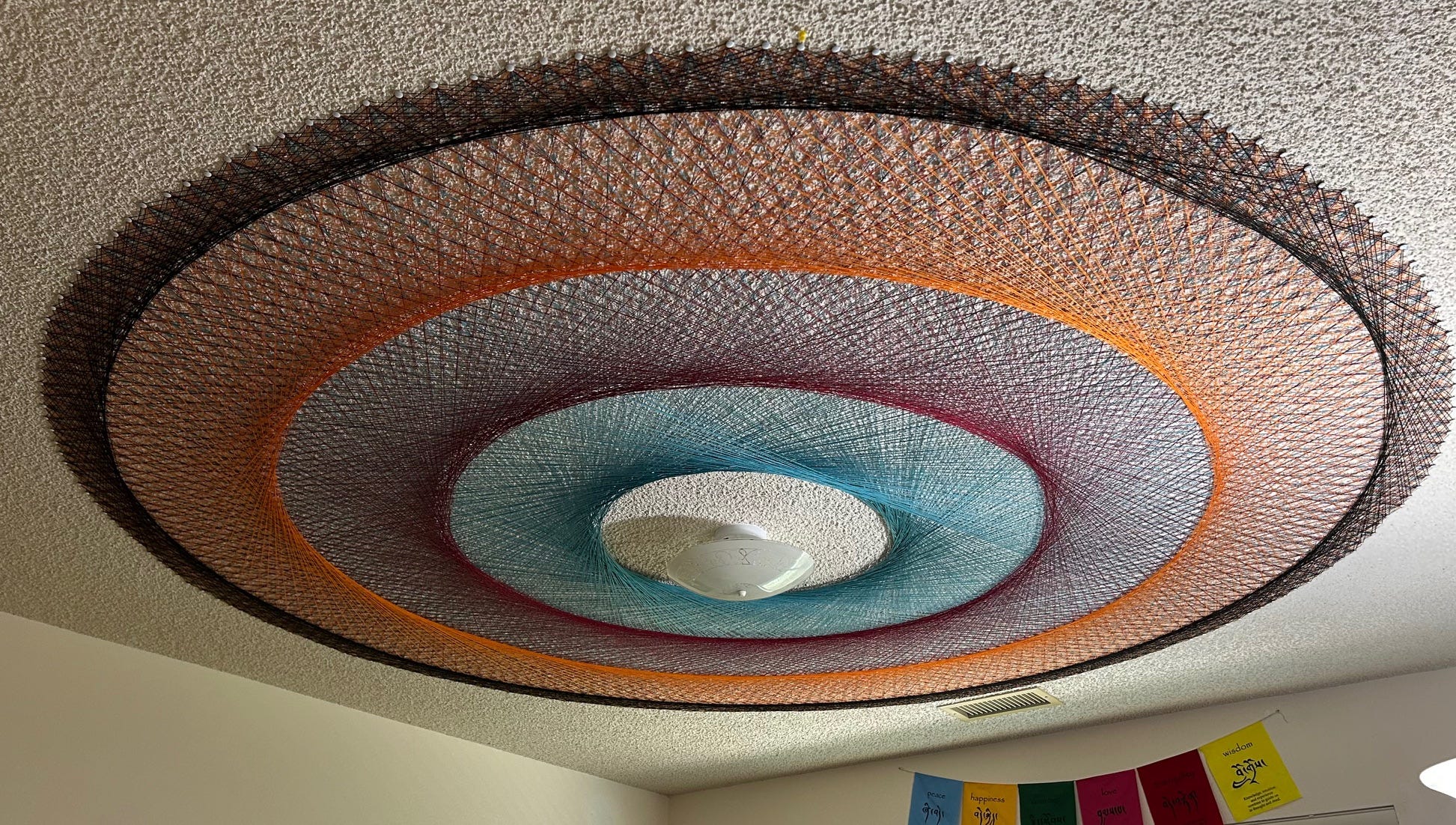
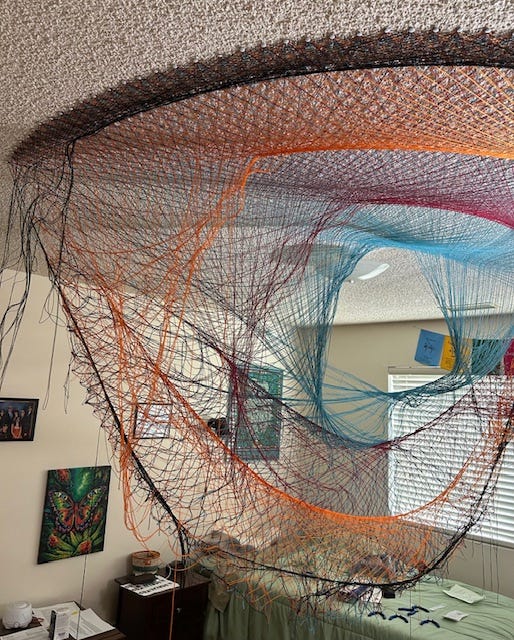
As the symmetrical artwork fell into a heaping, disorganized mish-mash of string, I remembered another design, a far more intricate one that I’d seen being created halfway around the world by Tibetan monks some 13 years earlier, and what they’d done to their artwork soon after it was completed.
Back in 2013, two friends and I embarked on a high-altitude trekking adventure to Nepal. Four days into our three-week journey to Mt. Everest, we slowly, laboriously ascended to the Tengboche Monastery, nestled at 12,600 feet in the shadow of several spectacular Himalayan behemoths.
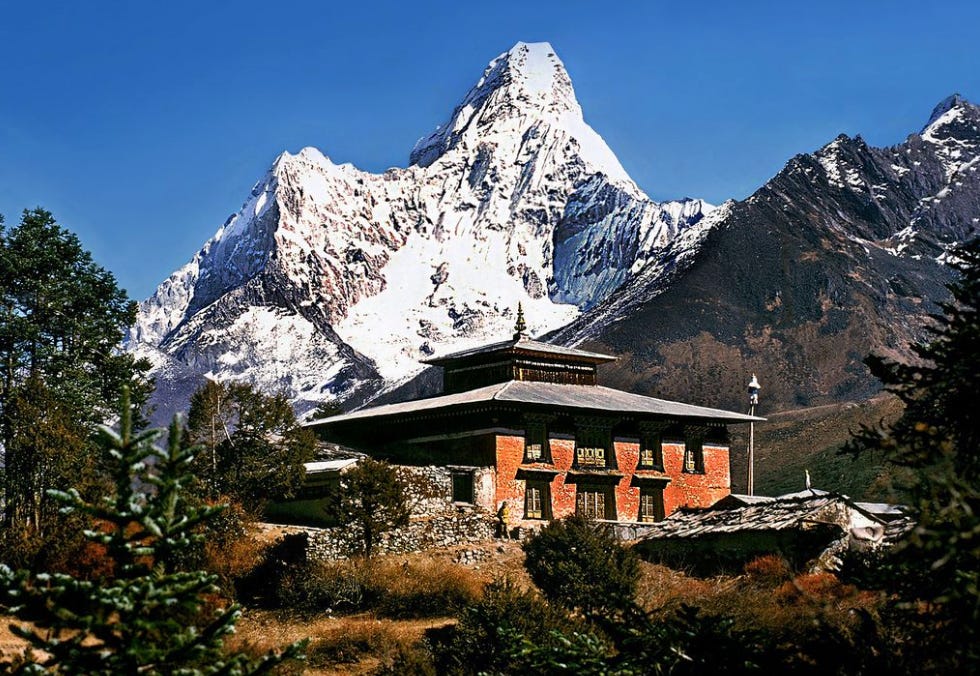
We had a layover day at Tengboche to acclimate. (When your ultimate goal is located at 19,000 feet, some 1,500 feet higher than Everest base camp, these rest periods are not optional, folks.) Given that we’d climbed 2,000 feet the previous day, we awakened that morning exhausted, dehydrated and dealing with mild altitude sickness.
Our spirits were lifted, however, upon discovering that four of the gentle, maroon-and-saffron-clad Tibetan Buddhist monks living at the monastery were creating a mandala, a stunningly colorful artwork composed of marble crushed into fine sand.
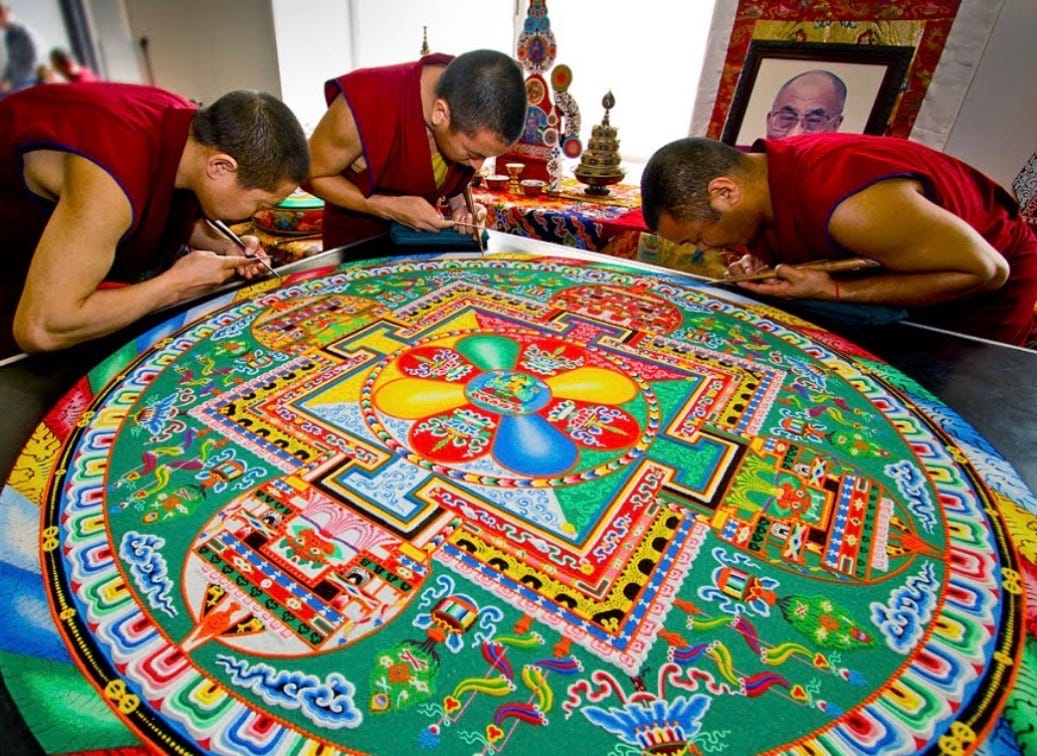
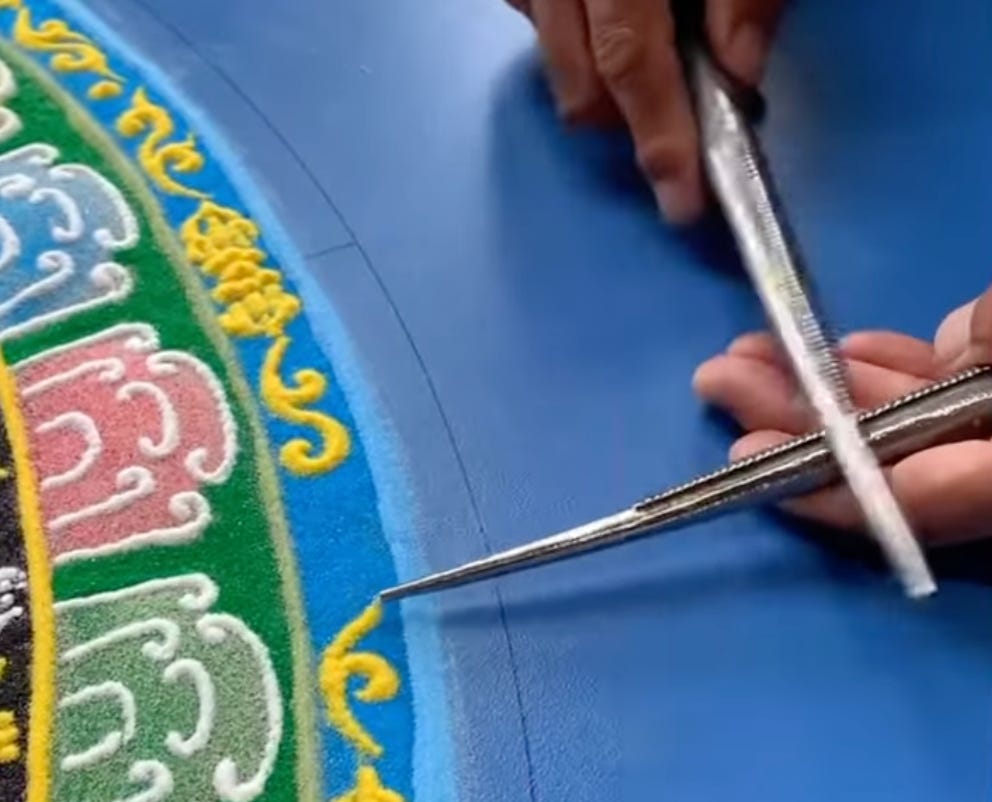
“I heard that the monks train for years to do this,” my friend Rex whispered as we watched the monks tap-tap-tapping a kaleidoscopic array of the powder-like substance through narrow copper tubes onto their half-completed mandala. “I mean, talk about discipline.”
“I wonder how long they’ve been working on this one,” said Reggie, an old college friend and seasoned big-wall climber.
“Guys,” I chimed in, keeping my voice down and pausing for effect, “what I wouldn’t give right now for a Black & Decker leaf blower …”
Though he knew I was joking, Reggie glanced at me with concern, fearing that one of the monks had picked up on my snarky comment.
“Dude, they didn’t hear me,” I said.
“I’m pretty sure they did,” Reggie replied.
“Doesn’t matter, right?” I whispered. “They don’t speak English.”
“My English is fine,” one of the monks said, turning in our direction and smiling. “And I know what a leaf blower is.”
My face, already sunburned by several days at high altitude, flushed with embarrassment.
“Sorry about that.”
“It actually was pretty funny,” he said, resuming his work on the mandala.
Despite our new friend’s forgiving nature, I half expected to start bleeding out of my eyes or having a seizure while babbling in Tibetan tongues, my instant karma for turning a sacred ritual into a throwaway one-liner. Thankfully, that never happened.
Tibetan Buddhist mandalas symbolize the impermanence of life, since the stunning works are ceremonially destroyed shortly after completion. The practice serves as a reminder that all things are transient, and it encourages mindfulness and an appreciation of the present moment.
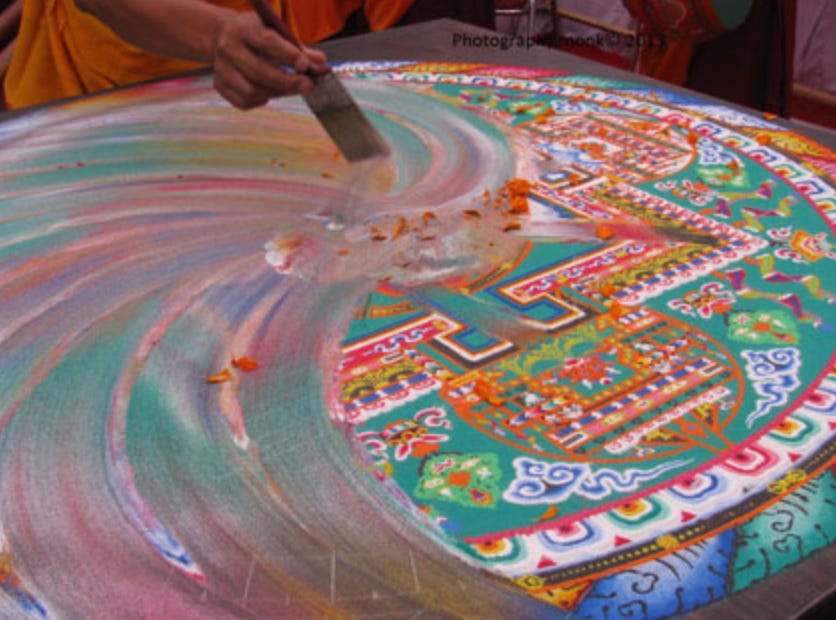
As Rex, Reggie and I ascended toward Everest in the days that followed, I occasionally wondered how I’d react if I were ever forced to destroy something I’d created with so much care. I found out years later, when it was time to take down my own mandala, of sorts. Let’s just say that destroying it wasn’t a day at Disneyland. Still, as I continued to pull the string design down, I was already drawing up another one to be installed in the new apartment.
This ongoing process serves as a reminder that impermanence is universal. What begins must end. What’s created is destroyed … and re-created. It’s unavoidable.
Impermanence, however, needn’t be synonymous with destruction. When it comes to major depression, for example, impermanence is a wonderful thing; it may even be life-saving.
Why? There may be difficult moments, days or even weeks – especially for those of us prone to dealing with what I call “The Beast” – when you find that “life” feels like a “life sentence” and you want to curl up in bed and simply quit.
One morning a few months ago, I awakened to find a 200-ton cloak enveloping my body and an infinite black void infesting my soul. If you’ve suffered from major depression, you know what I’m talking about, and my heart breaks for you.
The only two options that made sense were:
• Lie in a fetal position in bed, moaning, sweating and rocking myself in a feeble attempt at self-comfort.
• Pulverize my neurons for 12 hours, with a quadruple dose of nighttime meds.
At that moment, I knew beyond any doubt that this slow crawl through my little corner of hell would last forever. Sure, a distant part of me understood that I’d eventually feel better, maybe the next day or the next week. But, as I clenched my jaw and began to hyperventilate, I knew with absolute certainty that I was in this for the long haul. And, as such, “turning out the lights” (you know what I’m talking about) made perfect sense.
I felt better just one hour later.
Sadly, I know that if when the next such episode eviscerates me to my core, I’ll once again convince myself that this will last forever.
Note to self: Nothing, other than, perhaps, existence itself, continues for eternity. Nothing. It helps to remind myself that as often as possible; it allows a sliver of light to enter my dark soul just when I need that bright beacon of hope the most.
And I hope it helps you.
Your awful depressive episode (or your six-hour tax audit, blissful meditation session, horrific diagnosis, joyful surprise birthday party, gut-punch of a job loss, all of it) will end. Always. Always.
Nothing – the grotesque nor the good – lasts forever.
Many thanks to Rick Lewis and Kathy Ayers for their valuable feedback while this essay was being written. And major kudos to Rachel Parker, who suggested that this piece, what had been blended together with another story, deserved its own space. You were right!!
Oh, Larry. I’m so glad you gave this beautiful piece the space it deserved.
I love the way you turn the idea on its head. Not only is beauty transient, but so is pain. The older I get, the more I find myself drawn to the wisdom in that, and in Buddhism in general. Life is so fleeting, and it is so easy to miss it if we aren’t present to the moment-by-moment experience of it.
This is such a moving piece, and I really admire both the wisdom and vulnerability it took to share it. Major kudos.
"When it comes to major depression, for example, impermanence is a wonderful thing; it may even be life-saving."
Love this, Larry, along with the whole piece. It is a very helpful framing, as we often over-index the lamentation about times/things/memories lost.