

The Gag Family Photo
My brother taught me about the odd contradictions of being human.

The Groucho Marx gag glasses were thrown inches over my head like a Major League fastball. Had I not instinctively ducked, it might’ve tagged me square between the eyes, perhaps my brother’s intended target.
Briefly stunned, I looked toward Jeff, who was striding away in anger. I then turned to retrieve the item thrown at me a moment earlier: plastic glasses attached to a fake nose and mustache.
My mother and father had booked a weeklong cruise aboard the Grand Princess ocean liner, bound for the Mexican Riviera, to celebrate their 50th wedding anniversary. Along with my parents and myself, the clan included my two siblings and their respective families. The 10 of us had left San Pedro Harbor two days earlier.
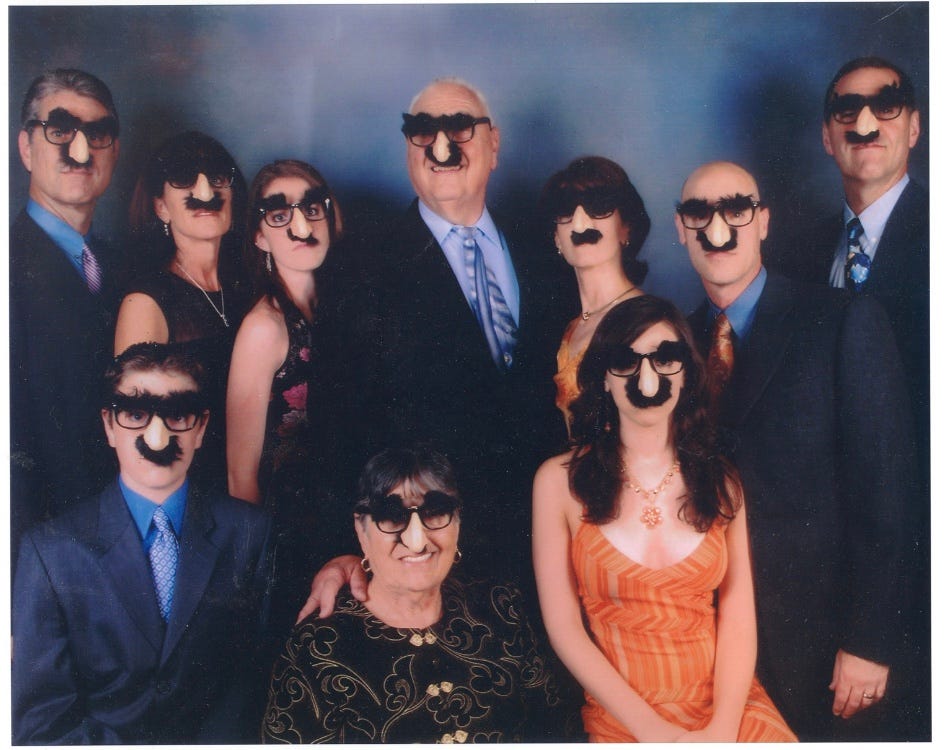
The cruise’s only formal dinner, an event when everyone got gussied up in their fanciest apparel, took place during our third evening at sea. Prior to the hoity-toity affair, we’d all planned to gather and pose for a family photograph.
To me, wearing a suit and tie was about as enjoyable as a Lidocaine-free root canal, one administered by a hungover first-year law student. However, I had an idea that would add an amusing, quirky element to the occasion: Once the traditional family photo was taken, everyone in the family would then don a pair of those joker glasses for a gag shot.
I knew that if I could get the family patriarch on board with this, the rest of the motley crew would fall in line. Given that my conventional father tended to eschew anything offbeat, I anticipated having to sweet-talk the ol’ boy to convince him to go along with the idea.
My concern was unfounded. “I think it’s a great idea, Lar,” Dad had said, chuckling. “Let’s do this!”
So we did.
Jogging slowly and slipping past scores of other formally attired cruisegoers, I caught up to my brother and tapped him on the shoulder. “I think this is yours,” I said, offering him the glasses. “You might’ve dropped it.”
“Keep it,” he said, pivoting away and heading toward the oceanliner’s grand dining room.
“No, you take this,” I said, my sarcasm ramping up a few notches. “I’m sure it’ll trigger warm and fuzzy memories.”
“This,” Jeff said, nodding toward the glasses in my hand, “was really stupid.”
“No, Jeff,” I replied. “This was a lot of fun … at least to anyone with one molecule of humor.”
“Goofy weirdo,” he jabbed.
“Vanilla normie,” I countered.
We barely spoke for the remainder of the cruise.
It took me many years to finally notice an odd, frustrating pattern: Whenever I did or said anything that put me in the spotlight – something that garnered even the tiniest bit of attention – my brother either said something disparaging, or he simply left the room. I never understood why.
The reason became clear one day about 10 years after the anniversary cruise. I was residing with my 87-year-old mother, who, after my dad died, could no longer live on her own. One day, when my brother stopped by, the three of us gathered together to catch up.
Prior to Jeff’s visit, my mom promised me that she’d do something that I’d loved since I was a wee little rug-rat: scratch my head. Granted, the idea of an octogenarian scratching her grown son’s head may sound a bit weird. In any event, Mom enjoyed watching me, someone prone to intense bouts of anxiety, sigh and melt like butter whenever her fingernails began to massage my scalp. The experience helped cement a deep connection we’d been afraid to fully articulate – and it felt divine.
She sat next to Jeff on a brown couch, while I collapsed into a recliner. After chatting for a few minutes, Mom informed Jeff of her promise to scratch my head, that he was to vacate his place on the couch for his younger brother.
“Get up, Jeff,” she said, smiling and playfully backhanding him on the leg, adding, with a tone of a mock drill sergeant, “Let’s go! Move it!”
My 60-year-old brother – always the picture of calm, measured equanimity – immediately erupted with, SHUT THE FUCK UP!! at our mother while slamming both meaty fists into the couch.
The air now sucked out of the room, Mom and I glanced at each other in shock. Jeff took on an expression of what I can only describe as befuddled horror, as he realized the enormity of what he’d just done.
But he never apologized.
You may find it hard to believe that someone with a vested interest in keeping me in my place, a person seemingly threatened by my tiniest acknowledgement, would also be the most helpful and supportive person I’ve ever known. Yet it’s true.
Any time I’ve needed any help – a word of encouragement, a dose of measured, level-headed advice, or a no-nonsense kick in the ass – Jeff has never failed to be a mensch and offer help. He’s provided sage advice when I was out of work; opened up his home after I mentally and emotionally bottomed out; encouraged me to create a personal budget after years of what I now call “spending in the dark”; stood up for me when I couldn’t or wouldn’t stand up for myself; and pulled me back from the ledge, repeatedly, when I was about to do or say something that would’ve ended badly.
He was also there during the most stressful moment of my life. That occurred in 2012, when I received potentially devastating news.
“What’s up, Larry?” my brother had said, answering my call.
“I’m sick, Jeff.” I said as I felt myself unraveling. “Bladder cancer. I – I don’t know what to do.”
“Jesus, Lar … How can I help?”
I only managed to stifle a sob.
“What are your options? What did the doctor tell you?”
“I don’t remember ... I can’t …”
“Listen,” Jeff said. “First, slow down. And breathe.”
“Okay … okay.”
“Call the doctor back – like, now. You gotta find out what’s going on, what we can do moving forward.”
“I’m not sure I can –” I managed to say as I burst into tears.
“Just do one thing, okay? Make an appointment with the doctor. Tell him it’s urgent.”
“What’ll that do?”
“I’ll join you at the doctor’s, and we’ll figure this out. Just let me know when. I’ll be there.”
My brother has always been there, answering the call.
So I occasionally wonder how a family member who’s made a life of minimizing my little wins and putting me down could nevertheless bend over backwards in times of need. But I have a theory, one that emerged the very moment Jeff blew up at our mother that day so many years ago.
After his outburst, as we all sat in stunned silence, pieces of the fragmented jigsaw puzzle that had been our relationship coalesced into a clear picture. By erupting with rage, Jeff had reverted to a petulant two-year-old, a toddler who, for decades, had been uncomfortable with any acknowledgement on my behalf. And that repressed child didn’t like taking a back seat to his little brother.
To the first-born Golden Child of the family, the kid who ruled the roost alone for an entire year before I came into the picture, I’ve always represented a significant existential threat, a threat he’s never been able to articulate, let alone admit.
My unforgivable infraction? Being born.
Dad loved my gag photo idea, and he shared his approval with the entire family. And Mom literally kicked her first-born out of the couch so her younger son could replace him.
That might enrage any two-year old, particularly a two-year-old trapped in an adult body who has never processed deep-seated early-life feelings.
Then again, maybe he’s always just hated me.
As for the numerous times he’s been there for me, dropping everything to be by his little brother’s side during times of need, perhaps each incident has always represented a chance for the Golden Child to be the hero, recognized by Mommy and Daddy as the proverbial knight in shining armor.
Then again, maybe he’s always just loved me.
My brother’s behavior has taught me that, as flawed human beings, we are rarely consistent or fully self-aware, nor are we reducible to our worst or best moments.
The day he exploded at our mother, I saw how quickly we – each and every of us – can slip back into old, unexamined places, how easily affection can feel scarce, how early deeply seated fears can hang on, long after we’ve outgrown them.
Today, when I look at that old family photo – the ten of us dressed up, wearing those silly glasses – I no longer see a fun moment that went sideways. Rather, I see a family, frozen in time, doing the best it can with the tools it has.
And I see my brother, dismissive yet supportive, flawed yet somehow perfect.
He answered the call when I needed help more than ever.
And he’s answered it every time since.
Kudos to Rick Lewis, Kathy Ayers and Brigitte Kratz, friends in our Write Hearted community, who provided essential feedback as this essay was being developed.
This is what it looks like when love and old wounds share the same body.
Larry, only you could write an essay that makes me laugh out loud with a line like, “To me, wearing a suit and tie was about as enjoyable as a Lidocaine-free root canal, one administered by a hungover first-year law student,” and then a few paragraphs later, quietly floor me with such a nuanced, compassionate understanding of human behavior. There is a beautiful contradiction here in how we can wound each other and still show up, how love and rivalry can coexist without ever fully resolving. Your ability to look at these moments without flattening anyone into a caricature is a real gift. It is always a joy to read your work.