

Love Takes Wing
A tiny bird taught me so much about what it means to be human.

I entered The Perfect Parrot to a cacophony of screeches, chirps, tweets, caws and cackling, almost-humanlike laughter. Without hesitating, I headed through the pet store straight toward a large cage that contained about a dozen lovebirds. The small, vibrant creatures flitted about, darting from one end of the cage to the other, nibbling on seeds, fluffing out their wings and swiveling their heads back and forth in unending curiosity.
Except for one green lovebird, a quiet redhead perched on a branch in the far corner of the cage, frozen amid the blur of high-octane activity.
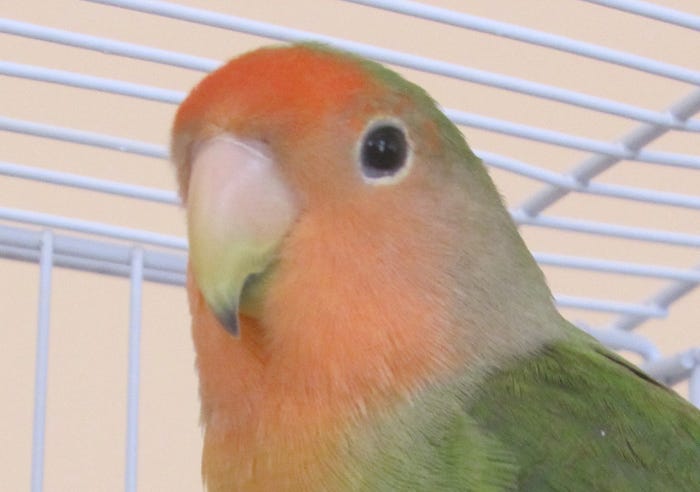
It was Lucy. I hadn’t seen her in two weeks.
Moving closer, I peered at the creature, smiled, briefly whistled through my teeth and said, “Hello, birdy … ”
She instantly came to life, jumping from her solitary position and gripping the side of the cage in front of me. Her head bobbed up and down in excitement as she began to chirp a familiar greeting.
I burst into tears.
Shuffling to an empty corner of The Perfect Parrot, head bowed, I convulsively wept harder than I’d ever wept before.
In early 2016, my 87-year-old mother could no longer live alone in the large house in Burbank, California, that she and my father had purchased some 40 years earlier. Since I was “between jobs,” I opted to move in with her, so she could avoid transitioning into an independent-living senior community, something she wanted to put off as long as possible.
Our only roommate, a yellow lovebird named Rocky, had, in his own way, helped support Mom during the challenging period after my father died three years earlier.
One day, Mom and I visited Dad at his gravesite, to pay our respects. On a whim, we took Rocky along.
Rocky died just three days later.
Sure, he was an old critter who we knew was going to fly from this mortal coil sooner than later. Still, Mom and I couldn’t help but wonder if he gave up the ghost after visiting the resting place of someone who’d been a good caretaker and friend for so many years.
When Mom eventually decided to get another lovebird, we headed over to The Perfect Parrot, in nearby North Hollywood.
Selecting a green bird sporting a spot of bright orange feathers on her head, we named her Lucy, after Lucille Ball, the famously feisty redhead.
I’d never felt any deep connection with pet birds, and this critter was no different. But my mother really wanted someone to replace her beloved Rocky, and I thought: For 50 bucks and a two-quart container of bird seed, how can we go wrong?
After we took Lucy home, she remained frozen, seemingly shell shocked, in one corner of her cage. But about two weeks later she came to life, singing, bouncing around her new digs and fluttering her way throughout the large house whenever we let her out for playtime. And we soon discovered that this spirited little bird was carnivorous, biting down on any unsuspecting finger within lunging range.
Lovebirds get their name due to their tendency to form strong, monogamous bonds with one mate. As the months went by, we noticed that whenever she was liberated from her cage, she’d bypass others and fly over to me, landing on one of my shoulders or, more often than not, atop my head.
Apparently, she chose me as her One True Love.
I was the only one who could pet Lucy’s red head without risking blood loss. She’d crawl down my shoulder onto my right collarbone, perch herself under my chin, and rest there for up to 30 minutes at a time. I soon realized that in adopting this oddly charming posture, we were nurturing each other.
Other times, we’d read together.
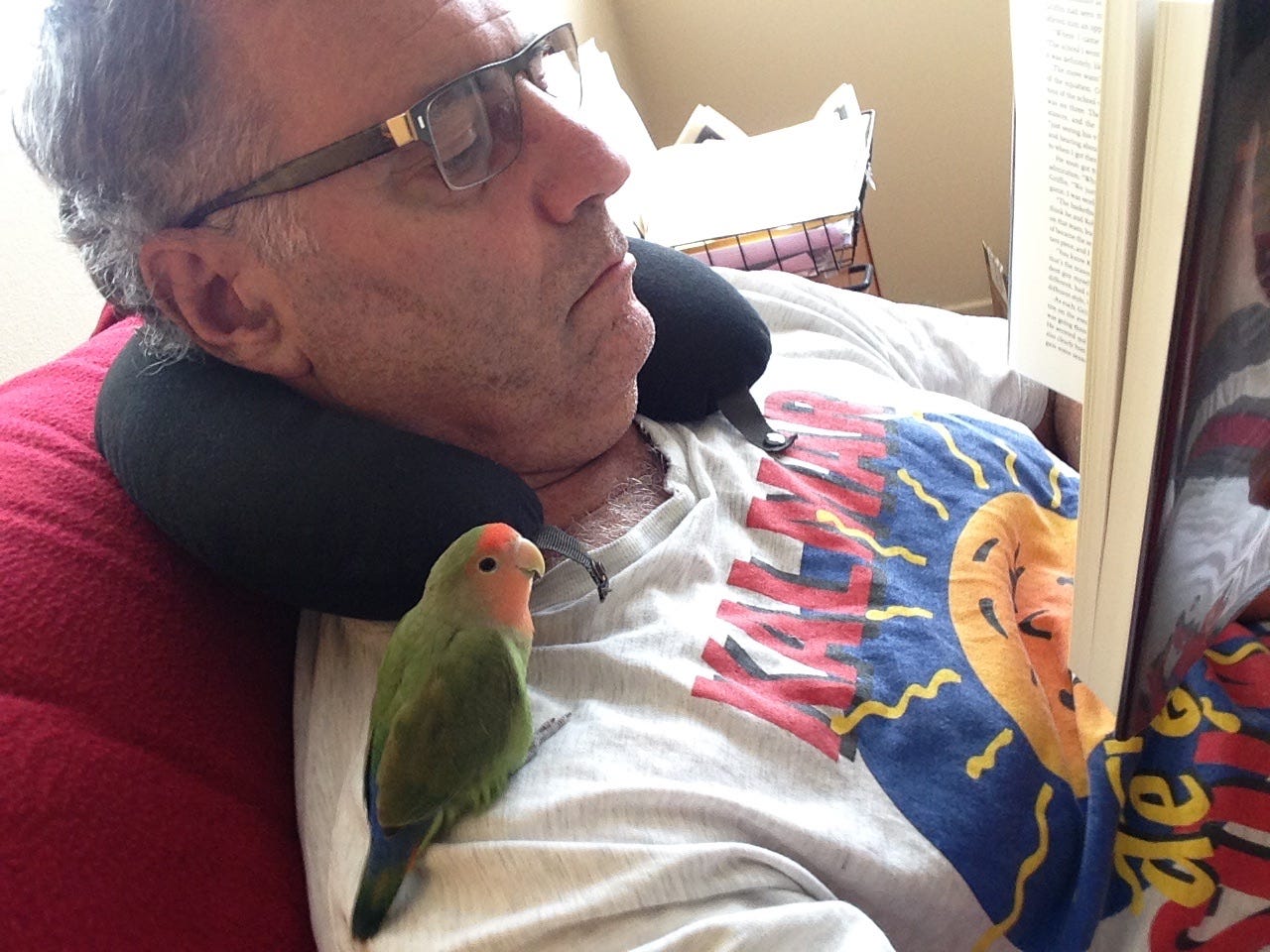
It only took two magic words to get Lucy to dart out from her little cloth bird tent, suspended from the top of the cage. “Hello, birdy.”
Three years later, my mother decided to sell the house and move into The Village, a senior independent-living community. (I later referred to Mom and her new neighbors as The Village People.) At the same time, seeking a radical change in the face of what felt like a lengthy period of stagnation, I made plans to pull up stakes and relocate to Prescott, Arizona.
But what to do with Lucy? Mom didn’t want the responsibility of caring for her, and I had no idea where I’d be living in Prescott, let alone how I’d make a living.
So one day, distracted and overwhelmed by the multitude of tasks required to make our respective moves happen, I returned Lucy to The Perfect Parrot. I had a lot on my plate, and I unceremoniously checked “dump the bird” off my to-do list without a second thought.
Done. Problem solved.
Spurred by a powerful urge, a day before my move to Arizona, I stopped by The Perfect Parrot to see Lucy one last time.
And there she was, frozen on her perch, mute and unmoving amid the gaggle of her energetic friends.
I moved my face close to the cage.
“Hello, birdy,” I said for the thousandth time.
Recognizing a familiar voice, she came alive and flew over to me, chirping and fluttering her wings.
I wept over an overwhelming sense of guilt. Yes, we’d bonded, and yet when it was time to care for this devoted little friend, I’d numbed out and abandoned her. How could I forgive myself?
To this day, I’m not sure I have.
But lurking just beneath the awful guilt was a far deeper emotion: profound love.
Standing in the corner of The Perfect Parrot, head bowed, blinking through my tears, I finally realized how deeply I’d become attached to this little creature. And it took this painful goodbye to finally connect with the depth of love I’d denied for so long.
I hope and pray that Lucy found a loving home for the long term. I think about her every day.
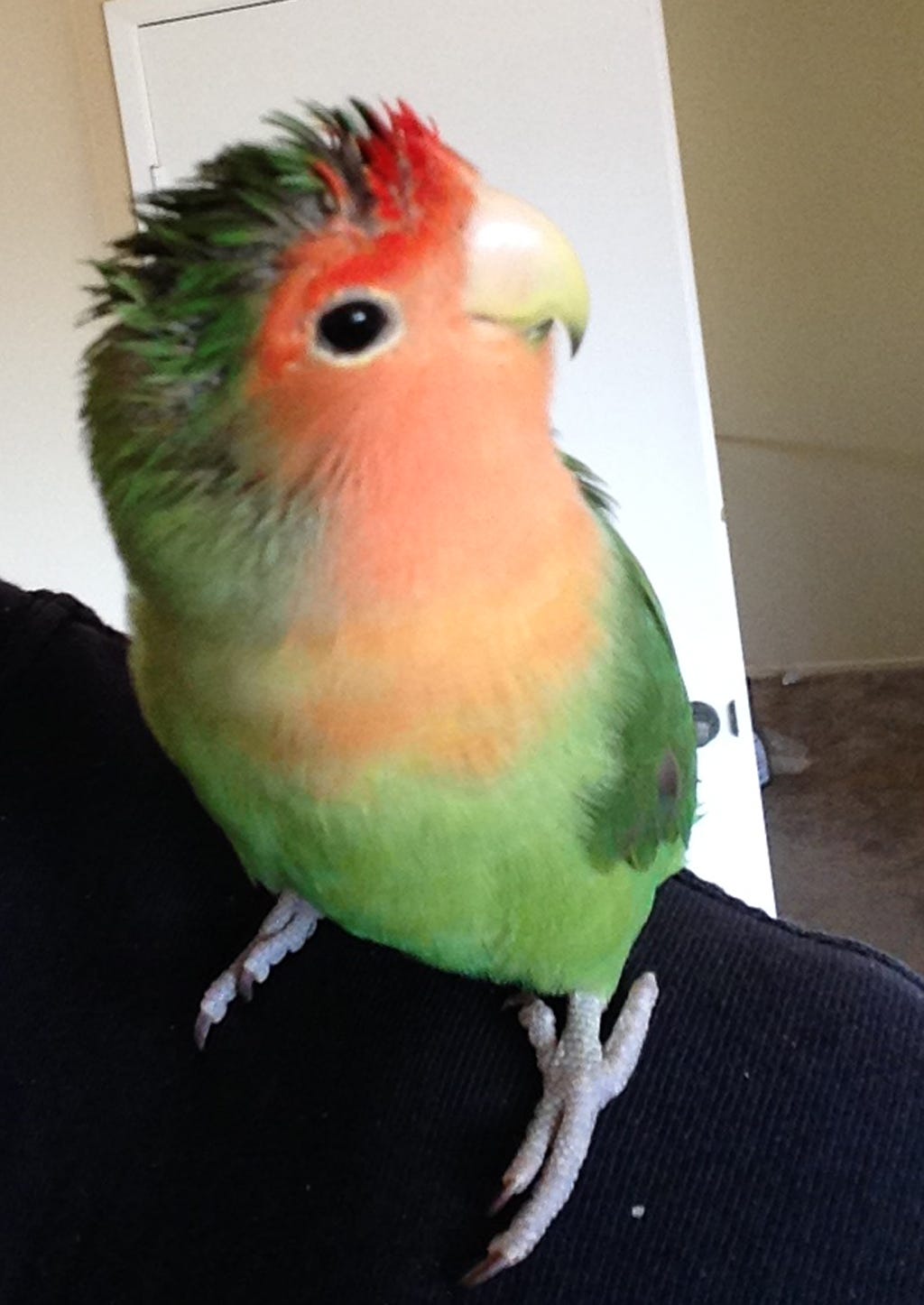
Such a moving story. I am so glad you had Lucy in your life. Who better to teach us about love, than a lovebird!!!
That picture of you with Lucy says it all.